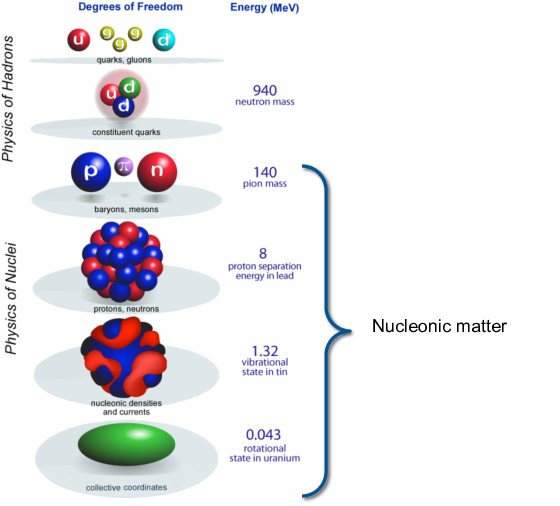
Figure 1: The many scales pose a severe challenge to first principle descriptions of nuclear systems.
The aim is to lay the foundation for the development of new activities in Computational Science and Physics at the University of Oslo, with a strong focus on computational technologies for the future, from quantum computing to machine learning.
The aim of our research program on multiscale physics is to develop a first principle approach to systems of relevance for a variety of fields, from materials science to nano-technology and biological systems and even atomic nuclei and stars.
Common to all these systems is that they entail a truly multiscale physics program that involves a proper understanding of the links between the various scales, starting from quantum-mechanical first principle studies of atoms, molecules and eventually other spatially confined systems to Density functional theories and finally microscopically derived potentials to be used in molecular dynamics calculations. Such a program involves insights and collaborations across disciplines in order to foster progress.
Figure 1: The many scales pose a severe challenge to first principle descriptions of nuclear systems.
Quantum Computing and Machine Learning are two of the most promising approaches for studying complex physical systems where several length and energy scales are involved.
The IBM Quantum Experience allows you now to test real quantum computing systems.
Traditional many-particle methods, either quantum mechanical or classical ones, face huge dimensionality problems when applied to studies of systems with many interacting particles.
To be able to define properly effective potentials for realistic molecular dynamics simulations of billions or more particles, requires both precise quantum mechanical studies as well as algorithms that allow for parametrizations and simplifications of quantum mechanical results. Quantum Computing offers now an interesting avenue, together with traditional algorithms, for studying complex quantum mechanical systems.
Machine Learning allows us to parametrize these results in terms of classical interactions. These interactions are in turn suitable for large scale molecular dynamics simulations of complicated systems spanning from subatomic physics to materials science and life science.
Machine Learning plays nowadays a central role in the analysis of large data sets in order to extract information about complicated correlations. This information is often difficult to obtain with traditional methods.
The research program will focus on two main topics: